Green Light Economy: The Path to a More Resilient Wellington Through Private Sector Growth
Updated: Aug 11
Introduction
Chair: Greg Pollock
I’m pleased to present this report for Wellington. Developed in partnership with Infometrics and Allen + Clarke, we are focused on how we can build a more resilient and successful capital city.
For 165 years, the Chamber has championed Wellington’s business community. We connect organisations, advocate at all levels of Government, and provide practical support - from employment relations to export growth - helping businesses thrive and lead.
Through challenges and change, we’ve remained committed to supporting our business community. Recent years have tested us all, from the pandemic to rising costs, but Wellington businesses have shown remarkable resilience and creativity.
Our city is uniquely positioned for growth. With strengths in science, technology, and the creative industries, Wellington has the right ingredients to thrive. We’re seeing new ventures emerge and established players expand, proving this is a great place to do business.
But there’s more we can do. Seriously looking at existing regulations and commercial rates could reduce pressure for the business community, and better alignment between our science, education, and professional services sectors could unlock even greater potential.
We’re committed to working closely with our members, the wider business community, and local and central Government to help shape a stronger future for Wellington. We hope the ideas in this report spark conversation and action.
CEO: Amanda Wood
I’m excited to present this report, which reflects the voices of over 1,000 members across the region.
Our members are deeply committed to Wellington’s success, yet many face persistent challenges, high rates, regulatory complexity, and fragmented support systems. Despite
their resilience, there’s a growing sense that the private sector’s role in shaping our city’s future is undervalued and underrepresented.
Wellington’s population growth and private sector performance continue to lag behind other comparable regions. But the city holds significant advantages: the highest proportion of tertiary-qualified workers in the country, world-class professional services, and a globally recognised creative sector.
This report outlines how we can better harness these strengths. It proposes a shared economic vision focused on enabling private sector growth, and fostering long-term, sustainable development.
We believe a stronger partnership between Council and business is essential. By working together, in conjunction with central Government we can unlock Wellington’s full potential and ensure our capital city thrives.
This report has been developed with feedback from key business leaders and is a testament to the private sectors commitment to Wellington.
We all want the city to grow and thrive, but this will only happen when Council and Government partner with business and sector leaders to deliver transformational change.
We look forward to engaging on the recommendations outlined in this report to help shape a more successful future for all Wellingtonians.
Executive of Policy Recommendations
Wellington stands at a crossroads. Our city possesses extraordinary advantages: New Zealand’s most knowledge intensive workforce, world-class creative industries, and consistent rankings among the world’s most liveable cities. Yet our growth is stagnant, and our private sector is lagging.
Wellington has historically been defined as a “Government town” when in reality, it is our private sector that has equal potential to unlock our future through employment and investment. This moment of transition presents an opportunity to reset our narrative and build on our existing private sector strengths.
This report presents a clear path forward: embracing and amplifying a new role as New Zealand’s green light economy. By creating conditions where the private sector thrives, we can build on existing success stories while attracting new investment and talent.
Key Recommendations
Priority Actions:
Create “Green Light” regulatory environment for business, startups and SMEs.
Take urgent action on reforming commercial rates to address Wellington’s highest in nation burden.
Establish Business Advisory Council with meaningful influence on economic development spending and strategy.
Launch Wellington Innovation Fund for co-investment with private sector to super charge our startup sector.
Strategic Initiatives:
Facilitate conversions of underutilised offices into 5,000 affordable housing units through proven models like the Te Kainga housing plan.
Redirect portion of commercial rates to business growth & startup initiatives.
Implement procurement preferences for local businesses.
Build innovation precincts in underused council properties.
Governance Reforms:
Strongly consider regional amalgamation for coordinated economic strategy.
Support Council review into CCO effectiveness and functions.
Implement ROI metrics for Council economic development spending.
A Data-Driven Case for Economic Transformation
Wellington has extraordinary strengths that often go uncelebrated. Our creative industries command global respect, from Oscar-winning film productions to cutting-edge game design. We consistently rank as oneof the world’s most liveable cities. When it comes to our skilled workforce, Wellington offers the best talent pool in the country for businesses.
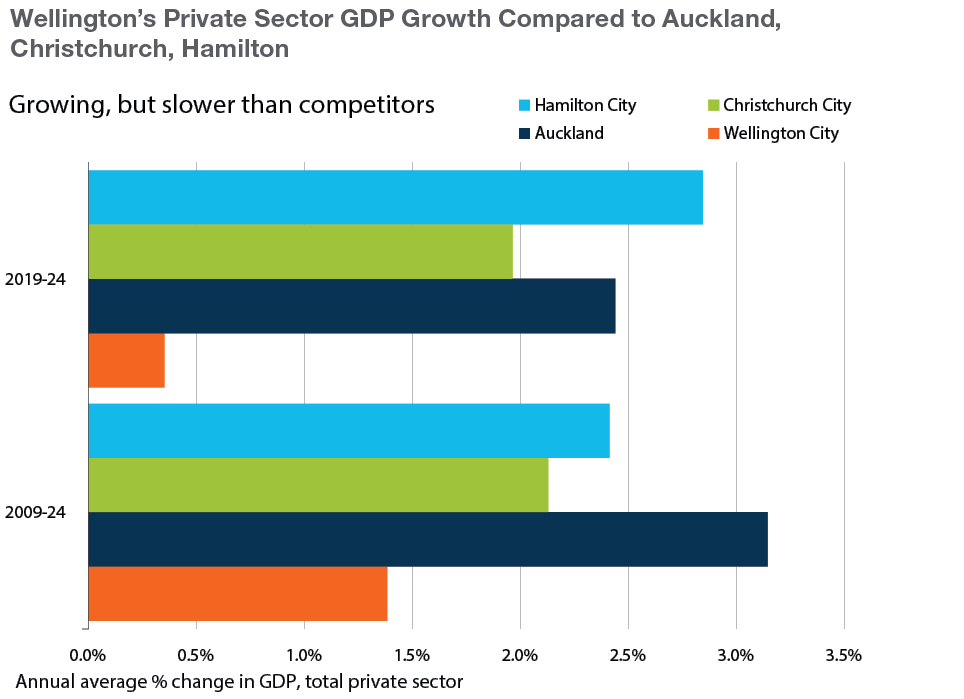
Wellington’s private sector employs most of our workforce, generates billions in exports, and includes globally competitive firms in technology, film, finance, and professional services. Yet between 2009 and 2024, our private sector GDP grew at an annual average of 1.4%, nearly half the rate of Hamilton (2.4%) and even further behind Auckland (3.1%). We’re not translating our strengths into momentum.
Wellington has the opportunity to embrace its identity as a diverse, innovative economy. The timing couldn’t be better – skilled professionals are exploring new opportunities, empty offices await transformation, and the city is ready for fresh thinking.
Most importantly, we must create pathways for ambitious talent who choose Wellington for its lifestyle but need career opportunities beyond government. They have startup ideas, creative ventures, and global ambitions. With traditional government career paths evolving, the urgency to highlight and expand private sector opportunities has never been greater.
The Numbers Tell a Clear Story
Over the past 15 years, Wellington has consistently trailed other New Zealand cities in private sector growth. This isn’t a recent phenomenon or the fault of any single Council. It’s a long-term trend that reflects our collective failure to recognise and unlock private sector potential.
The data reveals a crucial truth often obscured by “government town” rhetoric: Wellington’s economy is actually highly diversified. Professional services, technology, creative industries, and finance together employ more people than government. Yet we’ve allowed one sector to define our identity, undermining confidence in our broader economic potential.
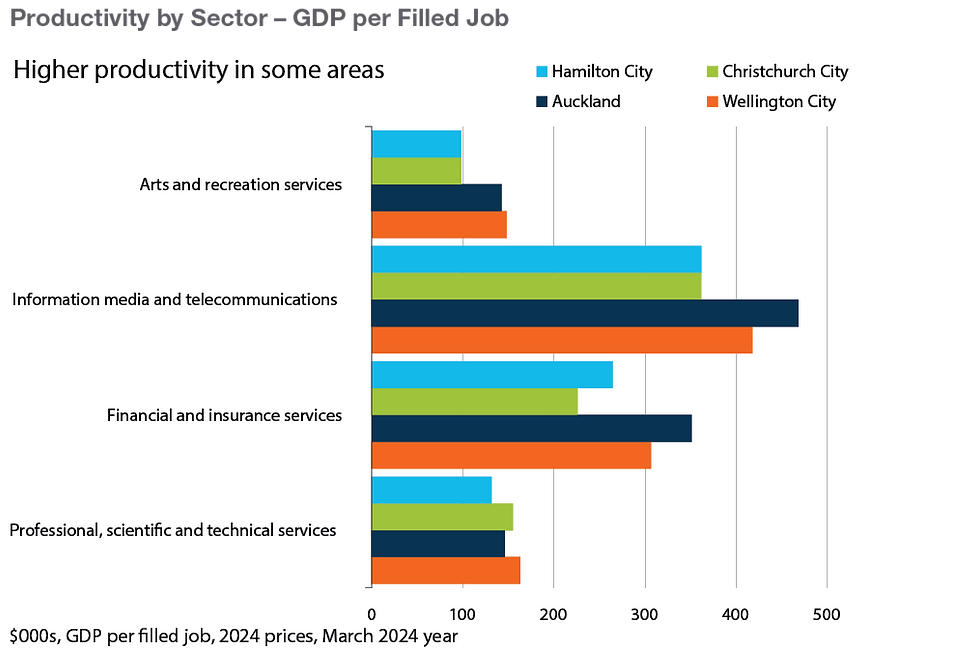
Our productivity data reveals significant bright spots. Professional services, finance, and ICT perform well above national averages, proving that Wellington can compete in high-value sectors. These successes deserve celebration and expansion, not overshadowing by outdated narratives.
Population growth tells perhaps the most concerning story. Since 1996, Auckland’s population has grown by over 60%, while Hamilton and Christchurch have each grown by approximately 40%. Wellington? Just 23%. This isn’t because we lack amenities or quality of life. It’s because we’ve undersold and under invested effort into our economic opportunities.


We Have All the Ingredients
Wellington’s advantages are real, substantial, and often underappreciated:
Highest proportion of tertiary-qualified workers in New Zealand.
World-class creative industries with proven export success.
Thriving tech sector.
High concentration of New Zealand business leaders.
Firmly established as New Zealand’s national decision-making centre.
Compact, connected city where collaboration happens naturally.
Strong university pipeline producing talented graduates and great research.
Connected and integrated science sector.
Professional services firms competing globally.
Film industry that puts New Zealand on the world map.
Direct access to highest decision makers in central Government.
World class nature and recreational activities that attract talent.
Rich culture of events, art and food.
What’s Holding Us Back
For a long time, Wellington has suffered from a lack of commercial focus and a narrative problem. Wellington has a successful private sector, but it is hampered by a clear lack of vision for commercial growth. Only when we plan for and enable growth, stimulate investment and cut barriers can we truly capitalise on Wellington’s potential.
Wellington also has the highest commercial rates in the country. Businesses here pay significantly more in rates relative to property values than anywhere else in New Zealand. This differential alone is an immense roadblock for business – we need to encourage business and have a rates policy that reflects this.
Several clear factors constrain our private sector growth:
High business rates: The highest in New Zealand, constraining growth.
Regulatory barriers: Rigid and expensive processes that hamper innovation.
Wrong focus: Lack of commercial focus and economic vision in political decision-making
Narrative problem: Private sector successes aren’t celebrated or even known.
Risk-averse culture: Government town narrative creates conservative mindset.
Fragmented support: No coordinated strategy for private sector growth.
Underinvestment: Economic development funding focuses on tourism over business growth.
Our Vision for Wellington’s Next Chapter: A Green Light Economy
Currently, Wellington has fragmented decision making. A development here, a rates increase there, a transport project debated in isolation. Without a shared vision focused on attracting and retaining talent to build sustainable, long-term economic growth, every decision misses the bigger picture.
Creating a thriving private sector economy isn’t optional. It’s essential for Wellington’s future. Business leaders and entrepreneurs don’t just create companies; they create energy, culture, and the next generation of employers. Lose them, and we lose our future.
A clear economic vision transforms scattered decisions into strategic choices. When we know we’re building a city for ambition, every policy decision has a reference point. Existing businesses can also benefit from this alignment since more young people means more consumers, and more highly skilled workers, all driven by Wellington being an attractive proposition on the national and international stage when mobility is easier than ever.
Our vision is a green light economy. Where businesses are born and scaled up, all within a cohesive and supportive ecosystem, backed by investment and sustainability. It is a city that is easy to do business in and one where businesses regularly work with Government to create the best outcomes and cut barriers holding back growth. It is a liveable city where every dollar spent is for value and every outcome is accountable.
To achieve this Wellington needs to meaningfully pursue the following four pillars with strategic intent, delivering meaningful reform and creating the results needed to transform the city:
Reform For Growth:
Governance and Business Voice
Innovation Capital: Where Companies Start, Grow and Thrive
Creative Launchpad: From Uni Project to Global Success
Liveable City: Sustainable Growth Through Smart City Design
Pillar 1
Reform For Growth: Governance & Business Voice
To truly embrace our identity as a diverse commercial capital, governance must evolve as a priority. Wellington businesses face some of the highest commercial rates in New Zealand yet have limited formal influence over how these funds are invested.
The disconnect between economic contribution and decision-making power undermines growth. Commercial ratepayers contribute a substantial portion of Council revenue (paying 48% of the rates burden according to the Wellington City Council Long-Term Plan Amendment and 2025-26 Annual Plan) but have minimal formal input into economic strategy. Economic development decisions are often made without sufficient business sector involvement. Council decision-making cycles, designed for thoroughness and consultation, can take months when businesses need responses in weeks. This governance gap helps explain why Wellington’s natural advantages don’t consistently translate to growth.
International evidence demonstrates that cities actively including business voices in governance achieve stronger economic outcomes. Copenhagen’s collaborative governance model between public and private sectors has driven sustained economic growth. Singapore’s Economic Development Board, with strong private sector representation, has helped create one of the world’s most competitive economies. Dublin’s economic transformation was accelerated through genuine public-private partnership structures. These examples show consistent patterns Wellington should adopt.
Fragmented regional governance compounds our challenges. The wider Wellington region encompasses 9 separate Councils (Wellington City, Lower Hutt, Upper Hutt, Porirua, Kapiti Coast, South Wairarapa, Carterton, Masterton, and the Greater Wellington Regional Council). Businesses operating across the region navigate different rules, timeframes, and processes in each jurisdiction. Economic opportunities requiring regional coordination often fail due to institutional complexity.
Modern governance requires transparency and agility. Current Council processes, while thorough, can obscure spending and outcomes across multiple budgets and organisations. Businesses struggle to track how their contributions are invested or what economic returns are achieved. Decision-making frameworks designed for stability and risk management can struggle to respond to dynamic economic opportunities. Wellington needs governance that reflects commercial realities while maintaining public accountability.
Key Policies:
Business Advisory Council:
Launch a new and improved Business Advisory Council, with real influence on the decisions that effect business in Wellington.
Made up of 8 key business leaders in Wellington, appointed by the Mayor and Council in conjunction with The Wellington Chamber of Commerce & business leaders.
Assigned to work at arm’s length from Council in an apolitical advisory role on economic development and growth spending, intended to give a strong business lens on city growth.
Members of the Council should be able to publicise their advice to council to ensure accountability and transparency on decision making.
This Council should also be involved in shaping a more comprehensive and effective economic strategy for the Wellington region.
Commercial Rates Review:
Analyse Wellington’s highest-in-NZ commercial rates burden and benchmark against other cities to identify competitive positioning.
Redirect portion of rates revenue to business growth initiatives.
Seek input from commercial rate payers on best uses for these rates going forward.
Implement LTP amendment to commercial rates within first year of new Council term.
Regional Governance Reform:
Serious exploration of amalgamation benefits to investigate and assess the best governance model for delivering growth and certainty of investment for Wellington.
Support Council review into effectiveness of CCO performance and assess whether current structures deliver value for money.
Transparency on Spending:
Dashboard showing all economic spending and measurable outcomes. Improving accountability, decision making and better informing ratepayers on the value they get for their spend.
Council to implement ROI requirement on economic development initiatives with a mandate to project and report economic returns. Ensuring spending is targeted, thought-through and accountable.
Procurement Reform:
Implement new procurement rules that require Council to consider the wider benefit to Wellington of awarding contracts to Wellington firms – easing access to procurement contracts for Wellington businesses.
Simplified tender process for contracts under $100k.
Regulatory Simplification:
One-stop shop for all business interactions with Council, ensuring regulatory barriers are addressed at pace.
Ensure existing businesses are supported to access funding and support mechanisms, particularly SMEs.
Pillar 2
Innovation Capital: Where Companies Start, Grow & Thrive
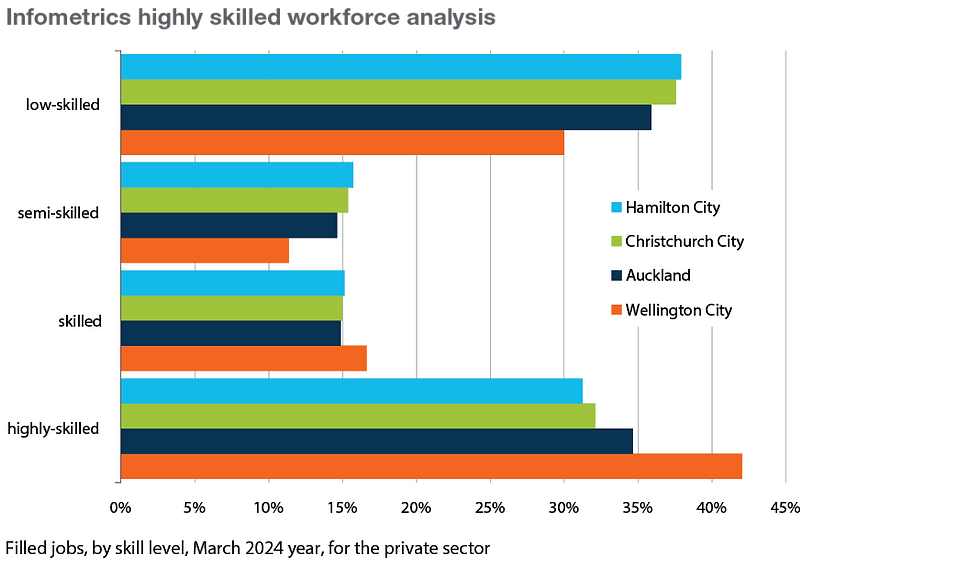
Wellington’s business ecosystem is far more developed than most realise. The Infometrics data shows that we have New Zealand’s highest concentration of tertiary-qualified workers: 42% compared to Auckland’s 35% and Christchurch’s 31%. This talent pool, combined with professionals exploring opportunities creates the perfect conditions for business growth.
Wellington’s unique advantages remain underutilised. Government as a potential first customer provides what many startups spend millions trying to access: a sophisticated buyer for innovative solutions.
Our compact CBD enables the casual collisions that spark innovation. Lower costs than Auckland mean capital goes further. These advantages become even more relevant as professionals seek entrepreneurial paths.
International comparisons reveal our potential. Austin’s evolution from a Government-centric economy to the renowned “Silicon Hills” tech hub was driven by decades of intentional support and investment. Boulder, a city smaller than Wellington, has fostered a vibrant startup scene and produced several high-value tech companies. Both cities succeeded by recognising their existing strengths and systematically building on them – exactly what Wellington must do.
To achieve this vision Wellington needs to not only promote growth, but build the infrastructure, funding and pipelines that incentivise it. With concerted effort Wellington can capitalise.
Key Policies:
Wellington Innovation Fund:
Build a co-investment fund modelled on successful international examples, funded between Council and venture capital/angel investment.
Managed by a board made up of relevant expertise, particularly in angel investment and venture capital.
Stipulation for funding is that companies must be based in Wellington, helping attract startups to build and grow in Wellington.
Building Innovation Infrastructure:
Convert underutilised buildings into startup hubs, creating a physical manifestation
of our startup ambitions. Comprehensive review of Council-owned buildings for startup/creative studio use to enable this.
Create a startup density map, enabling real-time visualization of Wellington’s innovation ecosystem, making invisible visible, including for job seekers, funders, and other startups.
Where applicable, look to co-locate startups with major business as means to encourage business opportunities and networking growth.
Launch “First Customer” Programme:
Procurement incentives for council targeted at local startups, leveraging our unique advantage.
Quarterly ‘problem solving day’ for Council and local business. Giving innovative companies the chance to pitch innovative solutions to problems set by Council – creating R&D and use-case opportunities.
Enable fast-track access to Council to address regulatory barriers as part of the programme.
Enhance Visibility:
Host major event positioning Wellington as a New Zealand innovation hub – supported by Council and Government.
Promote aggressive PR campaign highlighting Wellington’s existing startup successes, changing perceptions.
Create an aligned events strategy for universities, startups and tech sector leaders to enhance networking and commercial outcomes.
Make a concerted push to bring top talent to Wellington and make Wellington the most accessible city in New Zealand for highly educated and specialised talent.
Pillar 3
Creative Launchpad: From Uni Project to Global Success
Wellington’s creative economy represents one of our greatest uncelebrated strengths. The Infometrics analysis shows creative industries contribute 11% of our GDP compared to 8% nationally. Film and digital exports exceeded $800 million last year.
The global creative economy offers massive opportunity. Creative industries globally grow at 9% annually, double the rate of general GDP. Cities that invest in creative industries benefit from strong multiplier effects. For example, international benchmarks show that every dollar spent can generate up to $2.5 in wider economic value. Young talent increasingly chooses cities based on creative vibrancy.
Our creative advantages are substantial but undermarketed. Our creative businesses created a global reputation that we can leverage into the future. Our game developers compete internationally. Our design agencies win global awards. Musicians, writers, and artists choose Wellington for its creative community. Yet many creative graduates leave within their first years after graduation, not because they want to, but because they don’t see pathways to sustainable careers.
International examples show that the transformation can be done. Montreal successfully pivoted to become a gaming hub, with Quebec’s video game industry now employing nearly 15,000 people, mostly concentrated in Montreal. Melbourne’s creative employment has grown steadily, with creative workers now comprising 8.7% of Victoria’s total workforce. Austin’s “Live Music Capital” branding attracts talent and investment globally. These cities show that creative industries, properly supported, drive economic transformation.
Key Policies:
Creative Space Enablement:
Ensure appropriate space is available for creative businesses.
Enable 24/7 creative zones where noise and hour restrictions don’t apply, recognising creative work patterns and needs.
Establish at least one dedicated creative hub outside CBD for larger-scale creative work
Creative Career Pathways:
Structured programmes connecting students to industry, creating a talent pipeline that attracts and keeps people.
Partner with private sector and industry leaders to design and achieve this.
Enable equipment and space sharing of expensive equipment, reducing barriers to entry.
Create in Wellington Campaign:
Intentional marketing of Wellington as Australasia’s creative capital.
Highlight Wellington’s creative ecosystem, particularly for young creatives.
Pillar 4
Liveable City: Sustainable Growth Through Smart City Design
Wellington’s geography, positions us perfectly for 21st-century sustainable growth. Our compact urban form makes Wellington ideal for the global shift toward sustainable cities. Urban planning research consistently shows that dense cities use less energy per capita, generate more innovation per resident, and create higher economic productivity. Dense urban environments foster the face-to-face interactions that drive innovation and enable more efficient infrastructure delivery.
The changing office landscape accelerates opportunity. With hybrid work becoming permanent and some organisations downsizing, Wellington has significant underutilised office space. Rather than seeing this as a decline, it’s a chance to reimagine our built environment to respond to the future needs of the city. Converting offices to apartments creates affordable housing while maintaining urban vitality. Mixed-use development fosters resilient neighbourhoods that thrive regardless of economic cycles.
Wellington’s substantial portfolio of buildings requiring seismic strengthening presents both challenge and opportunity. With reduced office occupancy post-pandemic, building owners face a convergence of factors: seismic upgrade requirements, changing tenant needs, and strong housing demand. While acknowledging the challenges, this also creates ideal conditions for adaptive reuse. International examples show how cities transform constraints into catalysts: Copenhagen’s carbon neutrality commitment attracted billions in green investment and Singapore turned land scarcity into vertical innovation. Wellington can use this transition moment similarly.
Key Policies:
Office-to-Apartment Fast-Track:
Expedited consent for conversions meeting predetermined criteria, creating up to 5,000 new homes.
Cooperation between central and local Government to accelerate Te Kainga housing programme 3 for affordable housing.
Work to remove any barriers to development of high density housing, in cooperation with the private sector, central and local Government.
Mixed-Use by Right:
Encourage commercial-residential mixed-use development in all central city zones without needing additional resource consent.
Introduce urban amenity design guidelines that promote ground-floor vibrancy e.g. retail, cafes, community spaces, bike storage.
Encourage adaptive reuse of older buildings to combine office, residential, and hospitality within a single footprint.
Pursue public private partnerships (PPP) to deliver infrastructure and housing rapidly.
Green Building & Infrastructure Incentives:
Co-fund the installation of climate resilience infrastructure, such as rainwater capture, solar panels, and green roofs in central city sites.
Pursue sustainable transport infrastructure— like widened footpaths, and pedestrian-only blocks in areas targeted for residential densification.
Bring balance to multimodal transport investment, recognising the needs of commuters, business and overall city mobility.
Hospitality & Social Amenity Strategy:
Launch a “City After Dark” strategy to reinvigorate nightlife and support after-hours economy, including funding for live music, night markets, and public realm upgrades.
Provide targeted business rate rebates for new venues that open in underutilised or vacant areas.
Expand al fresco dining and flexible licensing rules for bars and restaurants, especially in laneways and pedestrian areas.
Introduce a licensing fast track aimed at delivering new hospitality venues, with licensing at pace to stimulate the hospitality sector.
CBD Rejuvenation:
Focus on creating a more hospitable nighttime environment; delivering more lighting for safety, special rideshare hubs (delivered in partnership with ridesharing operators) and investigate the cost of better and more frequent public transport within the CBD at night.
Implement a cleaner streets programme to improve the cleanliness and aesthetic appeal of the CBD, particularly in areas of heavy foot traffic.
Consider a revised events momentum strategy to ensure we are capitalising on the flow on effects for major events, like WOW, which has generated $323m over 20 years, directly boosting businesses across retail, hospitality, and accommodation
Youth-Friendly Transport & Amenity Network:
Create a “Mobility for Youth” initiative: discounted public transport for people aged 18–30 working or studying in the city.
Build more frequent direct active and public transport connections between universities, startup hubs, the CBD and residential clusters.
The Message to Local Government
Wellington stands at an inflection point. The shift in Government employment patterns has disrupted old narratives, creating space for new ones. We can continue understating our private sector strengths, or we can embrace our true identity as a diverse, innovative economy.
The infrastructure exists. The talent is here. The success stories prove our potential. What’s missing is recognition, deregulation and intentional support for the private sector that already drives most of our economy and holds the key to our future.
Cities worldwide have transformed by celebrating and supporting their private sector. They’ve recognised that economic diversity creates resilience, that business success benefits everyone, and that outdated narratives constrain growth.
Wellington has every advantage except confidence in our own private sector potential. This blueprint shows how to build on existing strengths, create new opportunities, and finally tell the true story of Wellington’s economy.
To achieve this vision everyone needs to come to the table. If growth is the agenda, the approach needs to be bipartisan – businesses are already here, but Council needs to enable them to grow, and crucially needs to work with the central Government to transform Wellington.
The moment is now. The potential is enormous. Wellington’s business
community is ready to lead and partner.
Download a pdf version of this report: